
Quick answer
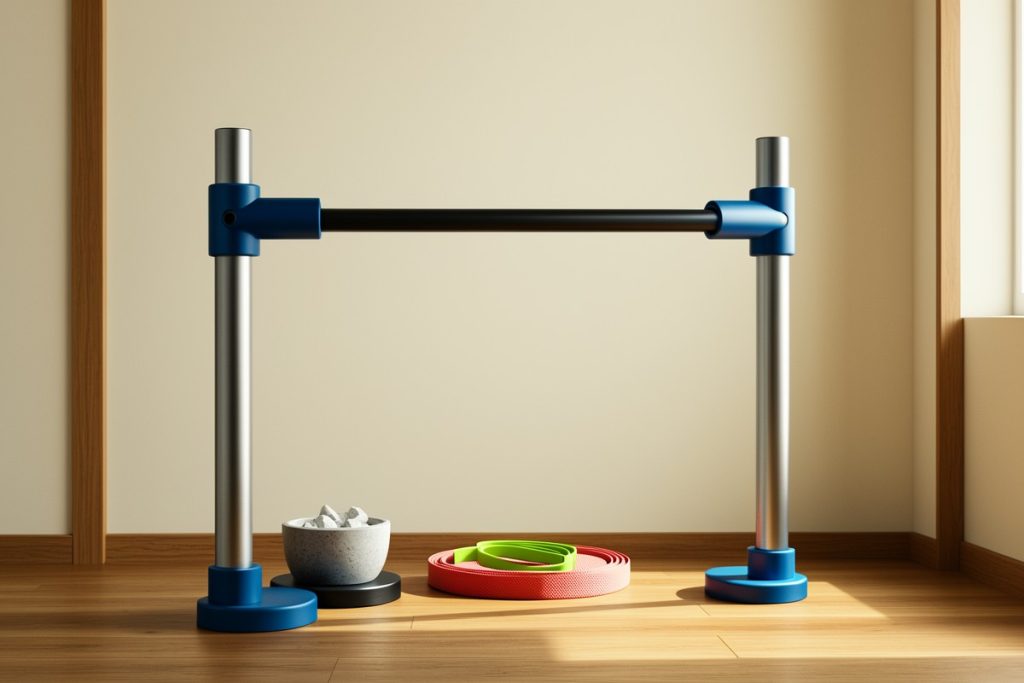
Loop a thick resistance band over your pull-up bar and step into it for assisted reps. Start with 3 sets of 5 to 8 controlled reps, using a band that lets you complete each set with one rep in reserve. Progress to thinner bands as strength improves, and supplement with dead hangs and slow lowering twice weekly. Most beginners build the strength for an unassisted pull-up within 8 to 12 weeks.
Key takeaways
- Band assistance lets you practice full range-of-motion pull-ups from your first session without sacrificing form.
- Advance by reducing band tension, not by chasing high-rep sets with poor technique.
- Dead hangs and eccentric lowering develop the grip strength and muscle control that bands alone cannot teach.
- Two focused sessions per week with at least 48 hours between them balances stimulus with tendon recovery.
Why Pull-Ups Belong in a Sustainable Fitness Plan
Pull-ups are one of the most efficient compound movements you can do. Each rep recruits the latissimus dorsi, biceps brachii, rear deltoids, and deep core stabilizers. Because they require only a bar and your body weight, they eliminate the need for bulky machines or gym memberships. That accessibility is the foundation of consistency, and consistency is what makes fitness sustainable over years rather than weeks.
The barrier to entry is real, though. A full bodyweight pull-up demands that you move 100 percent of your mass through space, which is why many beginners feel stuck after weeks of unsuccessful struggling. Resistance bands solve this by offsetting a percentage of your body weight so you can train the movement pattern with clean mechanics from day one.
What Makes Bands Ideal for Beginners
Unlike machines that lock you into a fixed groove, bands allow natural rotation of the shoulders and wrists. The assistance is greatest at the bottom of the rep, where the band is most stretched, which matches the point where most people need help initiating the pull. As you rise, the band relaxes and you carry more of the load yourself, teaching your nervous system to fire harder through the top portion of the movement.
This variable assistance creates a gentler learning curve than jumping straight into negatives or partner-assisted reps, both of which can overload connective tissue before it is ready. Bands also let you accumulate quality volume, something motor-learning research consistently links to faster skill acquisition.
Prep Your Body Before the Bar
Jumping straight into band-assisted pull-ups with cold shoulders is a fast track to irritation. Spend five minutes on scapular activation and blood flow. Perform two rounds of band pull-aparts, dead hangs on the bar for ten seconds, and shoulder circles. This sequence wakes up the muscles that stabilize the shoulder girdle, making each assisted rep safer and more productive.
The 4-Stage Progression Framework
Random band-assisted reps will make you sweat, but they will not guarantee a bodyweight pull-up. A clear progression is essential. This framework uses four stages, each defined by band thickness and the amount of assistance provided.
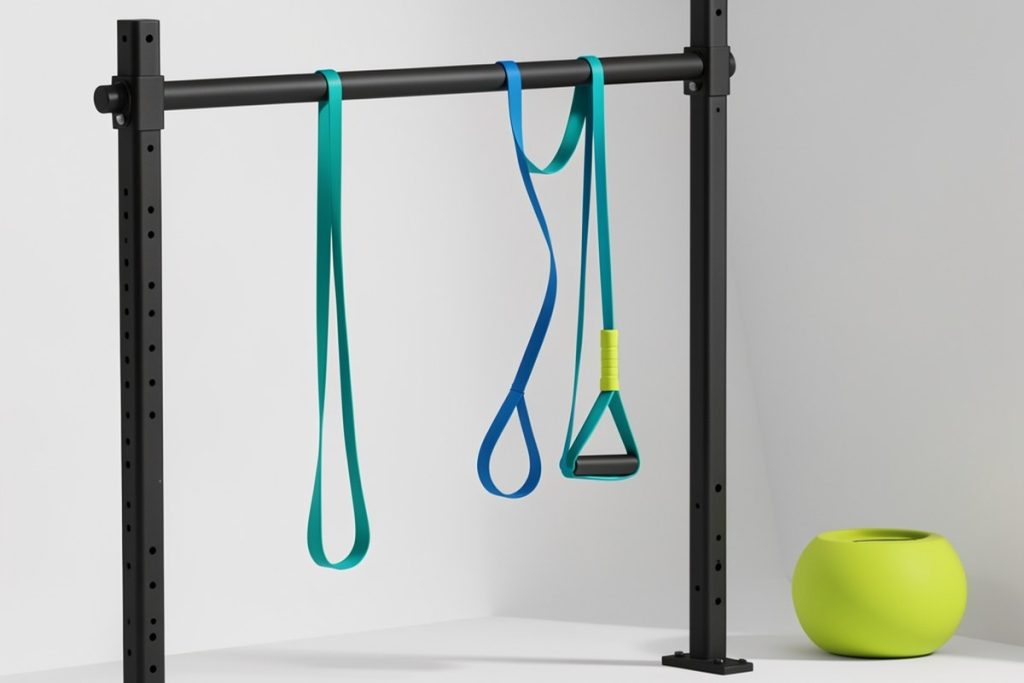
A complete set such as the Pull Up Bands, Resistance Bands Set gives you multiple resistance levels in one package, which means you can move through these stages without buying new equipment every month.
| Stage | Band Type | Rep Target | Goal |
|---|---|---|---|
| 1 | Heavy assistance | 3 x 5–8 | Learn the full range of motion with controlled tempo |
| 2 | Medium assistance | 3 x 4–6 | Build pulling power; one rep in reserve on each set |
| 3 | Light assistance | 3 x 3–5 | Feel the transition; minimize band help at the top |
| 4 | No band | Multiple sets of 1+ | First unassisted pull-up, then build volume |
Move to the next stage when you can hit the top of the rep range on every set for two consecutive sessions. If you fail early in the set, the band is too thin; if the last rep feels effortless, it is too thick. Honest self-assessment keeps you in the effective training zone.
Technique Checklist for Every Session
Quality matters more than quantity when you are learning a skill. Run through this checklist before your first set:
- Grip: Hands slightly wider than shoulder width, thumbs wrapped around the bar.
- Shoulders: Start from a dead hang with active shoulders, not a passive shrug.
- Core: Ribcage down, legs slightly in front of the body to prevent swinging.
- Path: Pull elbows down and back, bringing the chin over the bar without craning the neck.
- Tempo: One-second pull, two-second hold with chin over bar, two-second lowering phase.
The Accessory Work Most Beginners Skip
Band-assisted reps build the pulling motion, but they do not fully train your grip or the bracing required for a strict bodyweight pull-up. Add two movements to the end of each session.
First, dead hangs. Grip the bar without the band and hold for 20 to 30 seconds. When you can hold 3 sets of 30 seconds, your connective tissue is ready for heavier demands. Second, slow eccentrics. Use a box or jump to get your chin over the bar, then take four to five seconds to lower yourself to a dead hang. Perform 2 to 3 sets of 3 reps. These teach your muscles to control body weight without elastic help, closing the gap between band-assisted reps and your first unassisted pull.
Programming and Recovery
Train this pattern twice per week on non-consecutive days. A Monday and Thursday schedule works well. Perform your band-assisted work first, when your nervous system is freshest, then follow with dead hangs and eccentrics. Limit total pulling volume to 20 to 30 quality reps per session; beyond that, form breaks down and the elbows and shoulders take unnecessary stress.
Between sessions, prioritize sleep and protein intake. Tendons and muscle tissue repair during rest, and the adaptations you want happen when you are not training. If you are also doing heavy pressing or high-volume overhead work, place your pull-up days before those sessions so fatigue does not compromise your form. Recovery is not passive rest; it is part of the program. The tendons in your elbows and rotator cuff adapt more slowly than muscle tissue. If you feel aching at the front of the shoulder or inside the elbow, add an extra rest day. Sustainable strength is built by showing up consistently for months, not by grinding through pain.
When to Remove the Band Entirely
The transition out of band assistance is psychological as much as it is physical. Many beginners keep using a light band long after they no longer need it. Test yourself every two weeks. After a thorough warm-up, attempt one unassisted pull-up. If you get it, shift your training to bodyweight reps with longer rest periods. If you fail, stay with the light band for another cycle. Either outcome is data, not a verdict on your fitness.
Sources
Last reviewed: 2026-08-10