
Quick answer
Yes. A compact stair stepper can replace gym cardio for most home exercisers when used with intention. It delivers continuous lower-body resistance and elevates heart rate effectively in small spaces. While it lacks upper-body engagement compared to a rowing machine, 20 to 30 minutes of stepping meets CDC guidelines for moderate-intensity aerobic activity and burns comparable calories to brisk walking or light jogging.
Key takeaways
- A compact stair stepper provides legitimate moderate-intensity cardio that satisfies weekly aerobic recommendations in as little as 150 minutes per week.
- It demands significantly less floor space and maintenance than treadmills or ellipticals, making it ideal for apartments and small home gyms.
- Consistency matters more than machine type—three to four stepping sessions weekly improve cardiovascular endurance and lower-body strength.
- Look for hydraulic resistance, stable base rails, and a small footprint when choosing a unit for long-term use.
- Avoid leaning heavily on support rails; standing tall increases glute activation and calorie burn.
Why Stair Steppers Deserve a Second Look
Most home cardio conversations start and end with treadmills. They are loud, heavy, and require enough floor space to feel like a second roommate. A compact stair stepper flips that script. It is roughly the size of a large shoebox, operates quietly, and forces your body to do the one thing modern life avoids: push upward against gravity repeatedly.
That vertical motion is the secret. Every step recruits your glutes, quadriceps, calves, and core to stabilize while your heart rate climbs. You are not just moving; you are lifting your body weight with every repetition. That combination of resistance and steady-state effort is what makes steppers genuinely effective, not just convenient.
Here is the reality check most people need: you do not need a $2,000 machine to improve your heart health. The CDC defines moderate-intensity aerobic activity as any movement that raises your heart rate and makes you breathe harder. A compact stepper achieves this within the first three to five minutes for most users. The question is not whether the tool is fancy enough. It is whether you will show up and use it.
How the Compact Stepper Stacks Up Against Bigger Machines
Before you default to a treadmill because it feels familiar, compare the practical realities of actually living with these machines.
| Feature | Compact Stair Stepper | Treadmill | Elliptical |
|---|---|---|---|
| Floor Space | 1–2 sq ft | 15–30 sq ft | 6–8 sq ft |
| Noise Level | Near-silent | Moderate to loud | Low to moderate |
| Impact on Joints | Low | Moderate to high | Very low |
| Calories Burned (30 min) | 180–260 | 240–350 | 270–380 |
| Muscle Emphasis | Glutes, quads, calves | Lower body, some core | Full body if moving arms |
| Price Range | $80–$200 | $400–$2,000+ | $300–$1,500+ |
The stepper burns fewer absolute calories than a treadmill, but the gap shrinks when you consider consistency. A machine that lives in your closet because it is too loud or bulky does not burn any calories at all. The stepper wins on accessibility, and accessibility drives adherence. Research consistently shows that exercise adherence depends more on convenience and enjoyment than on maximal calorie burn per session.
A Simple 20-Minute Stepping Protocol That Works
You do not need an hour. You need a plan. Use this structure three to four times per week. Warm up for two minutes at an easy pace. Then step at a moderate tempo for 45 seconds, followed by 15 seconds of faster, explosive steps. Repeat that interval for 12 minutes. Cool down with three minutes of easy stepping, then finish with two minutes of bodyweight squats and calf raises to fully fatigue the lower body.
Track your progress by measuring total steps or total time, not by how soaked your shirt gets. If you can maintain a conversation but would rather not, you are in the right moderate-intensity zone. That is the sweet spot for building aerobic base without burning out.
For beginners, start with 10 minutes and add two minutes each week until you hit 25. Do not rush the progression. Your connective tissue adapts slower than your lungs, and patience now prevents knee or ankle irritation later.
Common Mistakes That Waste Your Time
A stepper is simple, but simple does not mean foolproof. The biggest error is collapsing your weight onto the handlebars or surrounding furniture. When you support your body weight with your arms, your legs do less work, your heart rate drops, and you turn a cardio session into a rocking chair simulation. Stand tall, grip lightly for balance only, and let your lower body drive the motion.
Another mistake is keeping resistance too low indefinitely. If you can watch a thriller without missing a word because of breathing, you are not working hard enough. Increase resistance or speed until the effort demands your attention. It should feel like a brisk hike up a steady incline, not a stroll to the mailbox.
Finally, avoid the temptation to step only forward. Some compact steppers allow a slight twisting motion through the hips. Engaging that lateral movement recruits your gluteus medius and obliques, turning a purely frontal-plane exercise into a more comprehensive core challenge.
Who Gets the Most Value from a Home Stepper
Compact steppers are not for everyone. If you are training for a marathon or need full-body conditioning, you will outgrow this tool quickly. But for specific groups, it is nearly perfect.
Apartment dwellers with thin walls and limited square footage can train without disturbing neighbors. Remote workers can step during conference calls without wheezing into a microphone. Beginners returning to exercise after time off will appreciate the low-impact nature and low learning curve. Busy parents can hop on for 15 minutes between obligations without a setup ritual.
If you fit any of those profiles, the stepper is not a compromise. It is a strategic choice that removes the friction between deciding to work out and actually starting.
What to Look for Before You Buy
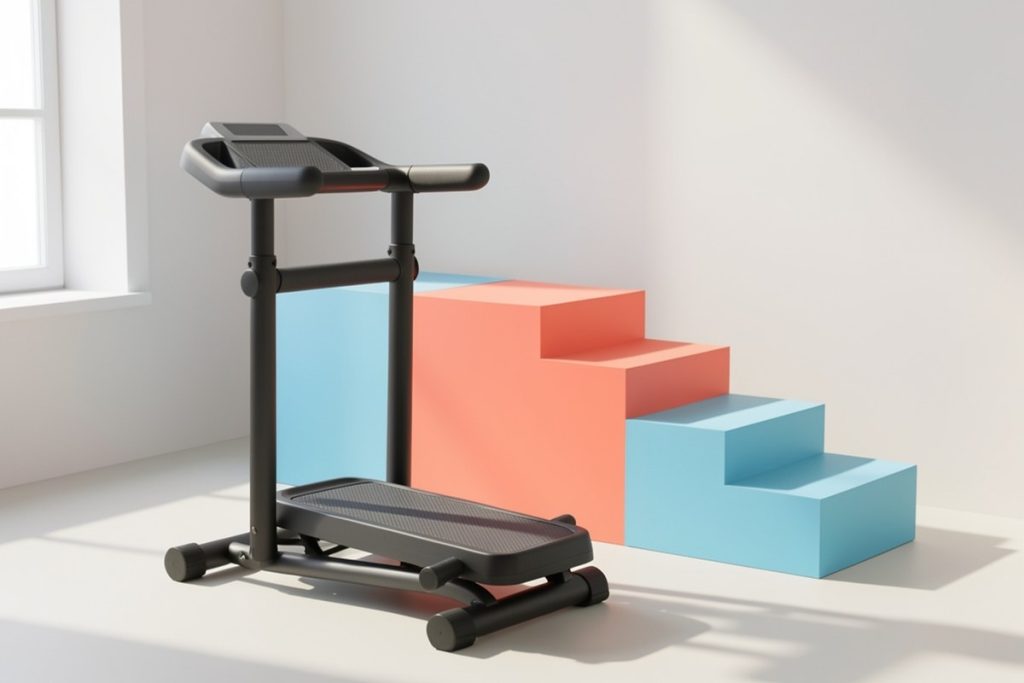
Not all compact steppers are built equally. Cheap units wobble, squeak, and collapse under aggressive use. Prioritize a wide, stable base with non-slip foot pedals. Hydraulic cylinders should offer smooth, adjustable resistance rather than a clunky on-off feel. Handlebars or resistance bands are useful but secondary; stability is primary.
The Sunny Health & Fitness Stair Stepper & Climber Exercise Equipment for Home Workout is designed specifically for compact cardio training and includes a stable frame with adjustable resistance—features that align with what actually matters for sustained home use.
Measure your available space before ordering. Most quality compact steppers need less than two square feet, but you will want clearance above your head and in front of you for safe mounting and dismounting. Place it on a mat to protect floors and dampen any minor noise. Check the weight capacity to ensure it matches your body weight plus any dynamic load from vigorous stepping.
Sources
Last reviewed: 2026-08-07