
Quick answer
You do not need a commercial gym membership to build a strong chest, shoulders, and triceps. A pair of adjustable dip bars provides a scalable calisthenics station that fits in a closet and lasts for years. With proper progressions and consistent programming, dip bars deliver compound upper-body strength that supports daily movement and long-term joint health.
Key takeaways
- Dips are a compound movement that simultaneously strengthens the chest, anterior deltoids, and triceps while engaging the core for stability.
- Sustainable progress depends on regressions such as bench dips and foot-assisted dips before attempting full bodyweight dips.
- A compact, load-rated dip station replaces multiple machines and supports progressive overload for years without subscription fees.
- Two to three brief sessions per week are sufficient for strength gains when paired with adequate recovery and pulling movements.
- Proper shoulder positioning—elbows tracking back, not flaring—reduces joint stress and improves muscle recruitment.
Why Dip Bars Belong in a Sustainable Home Gym
Sustainable fitness is about equipment that earns its floor space through versatility and durability. Dip bars check both boxes. Unlike bulky cable stations or plate-loaded machines, a quality dip station occupies roughly the same footprint as a yoga mat yet supports compound pushing movements, core work like L-sits and knee raises, and even passive stretching for the chest and shoulders.
The financial and environmental case is equally strong. A single purchase eliminates monthly membership fees, commute time, and the incremental waste of trial supplements or unused class packs. When you choose a steel frame with a high load rating, you are buying a decade of training potential rather than a gadget that ends up in landfill after a trend cycle. For anyone pursuing a minimalist home gym, dip bars offer one of the highest strength-to-space ratios available.
Anatomy of a Dip: Muscles Worked and Movement Patterns
Dips are a closed-kinetic-chain movement, meaning your hands remain fixed while your body moves through space. This pattern recruits the pectoralis major—especially when you maintain a slight forward lean—along with the anterior deltoids and triceps brachii. The core musculature contracts isometrically to prevent swinging, while the serratus anterior and lower trapezius stabilize the scapula against the rib cage.
Understanding this muscle map matters because it helps you feel the right tissues firing rather than dumping stress into the shoulder capsule. A proper dip is not a passive hang; it is an active plank for your upper body. When you depress and retract your shoulder blades before initiating the press, you create a stable platform that channels force through the prime movers instead of the connective tissue surrounding the glenohumeral joint. That stable platform is what allows you to add repetitions and load without inflammation.
The Beginner-to-Intermediate Progression Ladder
Most people abandon dips because they attempt full bodyweight before their connective tissue is ready. Tendons and ligaments adapt more slowly than muscle, so rushing the process invites elbow or shoulder irritation. Use the following progression table to earn each stage before adding load or complexity.
| Level | Variation | Goal | Key Cues |
|---|---|---|---|
| 1 | Bench or box dip | 3 sets of 10 reps | Feet flat, torso upright, elbows bend to 90 degrees |
| 2 | Foot-assisted dip | 3 sets of 8 reps | Light toe touch for balance, slow tempo, full range |
| 3 | Eccentric-only dip | 3 sets of 5 reps | 5-second lower, step up to reset at bottom |
| 4 | Full bodyweight dip | 3 sets of 5–8 reps | Slight forward lean, elbows track behind torso |
| 5 | Weighted dip | 3 sets of 5 reps | Add load only when 8 bodyweight reps feel easy |
Spend at least two weeks at each stage, focusing on controlled tempo and full range of motion. If you experience anterior shoulder discomfort, return to foot-assisted variations and emphasize scapular depression before each rep. Patience at the early levels builds the structural resilience that makes advanced dipping feel effortless rather than punishing.
Programming Your Weekly Dip Bar Sessions
Frequency beats intensity for sustainable strength gains. Two to three brief sessions per week provide enough stimulus for the pressing muscles while leaving adequate recovery time for connective tissue. Because dips emphasize the front of the body, balance each session with pulling movements—such as rows or pull-ups—to maintain shoulder health and posture.
A practical weekly template might look like this: perform dips on Monday and Thursday after a brief warm-up of arm circles and band pull-aparts. Complete three to four sets at your current progression level, resting two to three minutes between sets. Finish the workout with face pulls or reverse flyes to reinforce scapular stability. If you train full-body, pair dips with hinge or squat patterns so your session covers pressing, pulling, and leg work without exceeding 45 minutes. The goal is consistency, not exhaustion; leave two to three reps in reserve on each set so your nervous system recovers fully within 48 hours.
Equipment Considerations for Safety and Longevity
Before loading your bodyweight onto a station, verify the frame capacity and base width. Look for adjustable handle widths so you can shift between tricep-focused narrow positioning and chest-focused wide positioning as you advance. Rubber feet prevent sliding on hard floors, and a stable cross-brace matters more than extra features you will not use.
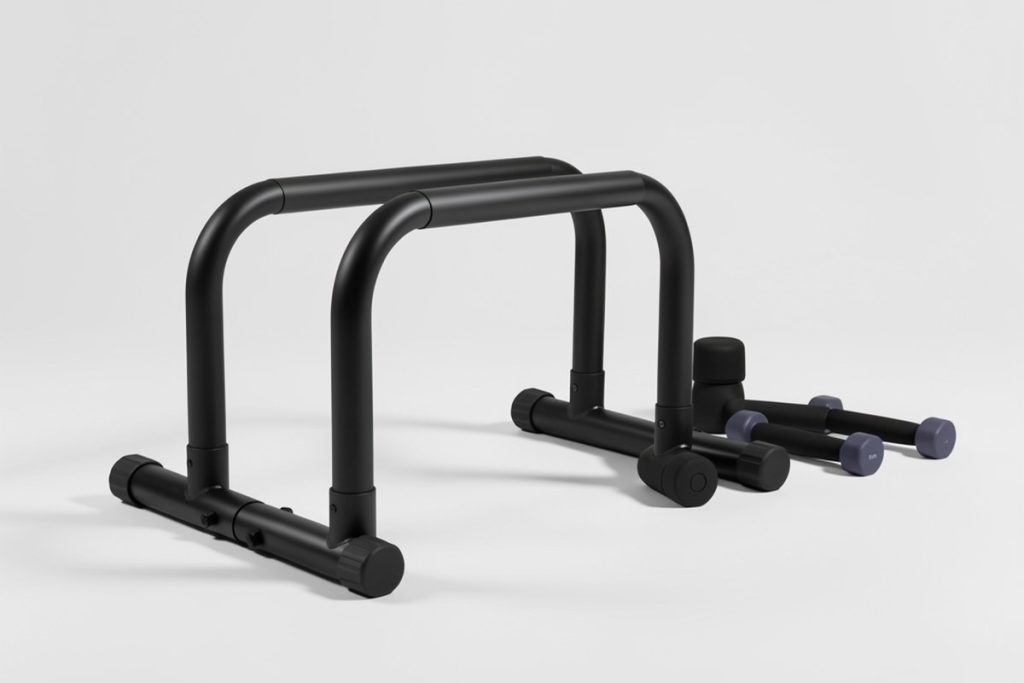
For a compact home setup, the Sportsroyals Adjustable Dip Bar Station offers a load rating up to 400 pounds and adjustable handle positioning. The heavy-duty frame suits progressive calisthenics without demanding a dedicated workout room, and the adjustable width supports both neutral-grip dips and L-sit holds as your skills advance. Always test the base on your specific flooring and confirm that all connection points are tight before each session.
Common Form Mistakes That Stall Progress
Elbow flare is the most frequent error. When your elbows wing out to 90 degrees from your ribs, the shoulder joint loses its packed position and the pectoralis minor takes over, increasing anterior shoulder strain. Keep your elbows tracking back at roughly a 30- to 45-degree angle so the load distributes through the chest and triceps.
Shrugging the shoulders toward the ears is another progress killer. This compression closes the subacromial space and can irritate the rotator cuff over time. Before you descend, actively pull your shoulder blades down and slightly together, as if tucking them into your back pockets. Finally, avoid half-repping. Partial range of motion trains partial strength and creates sticking points at the bottom of the movement. Lower until your upper arms break parallel with the floor, pause briefly to eliminate momentum, then press back to full elbow extension without locking aggressively. Control the descent, own the bottom, and finish strong.
Last reviewed: 2026-08-07