

Quick answer
A digital nomad city-day sling bag should carry only the essentials you need while walking, using public transit, or working away from your accommodation: phone, payment method, identification when necessary, medication, power, water, and weather protection. Keep it light, organized, and easy to secure. Your laptop, spare clothes, and larger accessories belong in your main travel bag.
Key takeaways
- Use a sling as a mobile essentials kit, not a smaller replacement for your backpack.
- Choose capacity around your actual bottle, battery, camera, and weather needs.
- Keep payment items, medication, and power supplies in consistent, easily reachable places.
- Check airline and airport rules separately before using the sling as a personal item.
By River Nakamura, Global Nomad Storyteller
The real job of a city-day sling bag
A city-day sling has a narrower purpose than a travel backpack. It keeps your essentials with you while you walk from an apartment to a café, transfer between trains, visit a market, or spend an afternoon exploring a new neighborhood.
The best setup is intentionally simple. Your laptop, spare clothing, toiletries, and collection of charging accessories should stay in your main luggage or work bag unless the day genuinely requires them. The sling should protect the things that would be inconvenient or expensive to lose, while making frequent-use items easy to find.
That distinction prevents two common problems. An overfilled sling becomes uncomfortable on one shoulder, and a bag packed for every possible emergency becomes difficult to search. Think of it as a daily operating layer rather than your entire mobile office.
Pack for real city friction
Build your loadout around situations you expect to encounter, not hypothetical ones. Most digital nomads can organize their essentials into four groups.
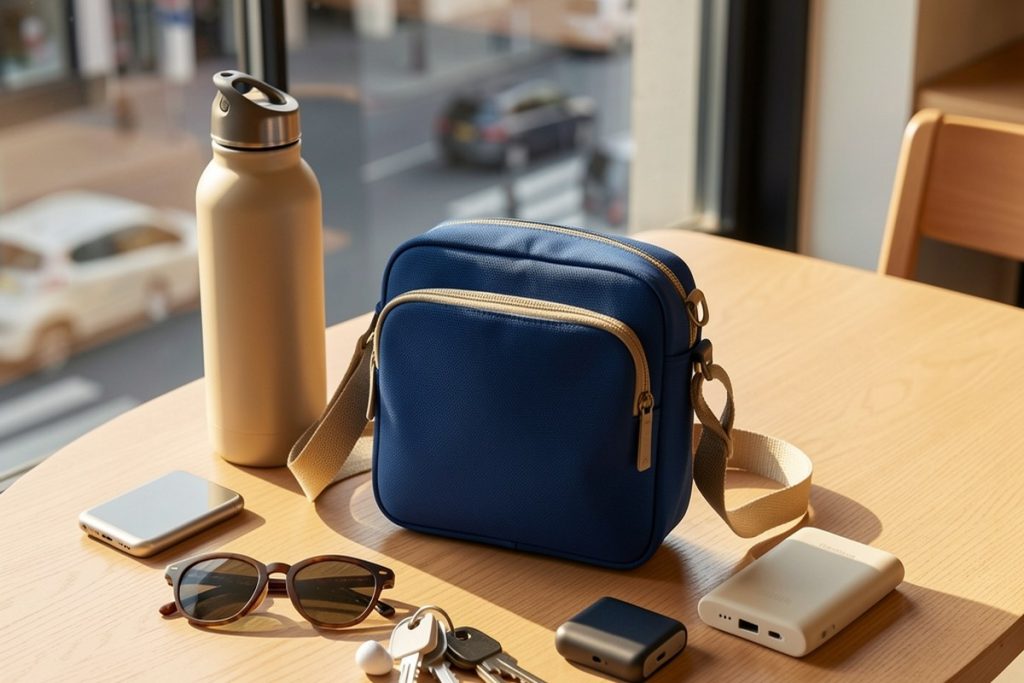
Identity and payment: Carry your phone, a small wallet, one backup payment method, and any local transit card you use. Bring your passport only when the day requires it. Carrying every bank card is usually less useful than keeping a backup card secured separately in your main luggage.
Communication and power: Add a short charging cable and a compact power bank if you will be away from outlets for several hours. Choose a battery that suits your phone and routine. A larger unit is not automatically better if it occupies most of the bag and rarely gets used.
Comfort and weather: Sunglasses, sunscreen, lip balm, tissues, required medication, and a small reusable water bottle can save unnecessary stops. In rainy destinations, use a small pouch for items that should remain dry. Add a light layer only when the forecast and itinerary justify its space.
Purpose-specific items: A compact camera, earbuds, snack, or small notebook may fit your day. A tablet, large camera lens, or full-size book may not. Before leaving, decide whether the day is mainly for walking, working, sightseeing, or an event. One sling cannot optimize for every activity.
A practical pre-departure checklist
- Phone and one payment method are present.
- Identification is secured only if you need it.
- Medication is packed in its normal labeled container.
- Power bank and cable are charged and compatible.
- Water, sun, or rain protection matches the forecast.
- The main zipper closes without forcing it.
- You can walk for ten minutes with the loaded bag without shoulder discomfort.
The final check is more important than it looks. A bag is not successful merely because it fits more. If it becomes irritating by lunchtime, you will either stop carrying it properly or start leaving essentials behind.
Choose capacity by your typical day
Capacity labels are useful starting points, but they do not tell you how a loaded sling will feel. A rigid bottle, camera, or bulky battery can consume space quickly. Shape, opening size, strap adjustment, and pocket layout may matter as much as the stated capacity.
| Typical city day | Practical bag direction | Main trade-off |
|---|---|---|
| Walking, transit, phone, wallet, water, and small personal items | Small sling | Light and discreet, but limited room for layers |
| Sightseeing with a battery, camera, or compact layer | Medium sling | More flexible, but easier to overpack |
| Tablet, large bottle, or several accessories | Larger crossbody or daypack | More capacity, but potentially less comfortable |
Before buying, lay your actual essentials on a table and measure the largest objects. Compare that bundle with the manufacturer’s internal dimensions rather than relying only on the capacity number. Check whether the largest item can pass through the opening, whether the strap reaches your preferred carry position, and whether the bag remains comfortable when worn at the front or back.
Where the tomtoc sling fits
The tomtoc Compact EDC Sling Bag can naturally fit the city-day problem when you want a compact crossbody for personal essentials instead of a full backpack. Its product listing presents 3L–10L versions and X-Pac or recycled-polyester material options, so confirm the specific size and material before ordering.
The sensible reason to consider it is portability and organization for a small daily loadout. It is not a substitute for a laptop bag, complete camera kit, or emergency luggage. A larger version may encourage overpacking, while a smaller version may not fit your bottle or camera. Crossbody bags can also create pressure when heavily loaded. I have not personally tested this product, so compare the listed measurements with your own objects and expected weight.
If you are unsure, pack your essentials into a temporary pouch or existing bag for a full walking day. That test will tell you more than a capacity label: you will discover whether you need extra room, whether the bottle is too bulky, and whether you actually prefer a sling to a lightweight daypack.
Keep airport use separate from city use
A sling can be convenient at an airport, but its usefulness does not override airline or security requirements. Baggage allowances and personal-item dimensions vary by airline, fare, aircraft, and route. Check the operating carrier’s current policy rather than assuming that every crossbody qualifies as an under-seat item.
Security procedures also vary by airport and country. For flights departing from the United States, the Transportation Security Administration generally limits carry-on liquid containers to 3.4 ounces or 100 milliliters, subject to stated exceptions and screening procedures. Pack liquids where they can be inspected without unpacking the entire bag. International airports may apply different processes.
Power banks and spare lithium batteries also deserve attention. Keep them accessible and check the applicable airline guidance before flying. If the sling is your personal item, leave enough flexibility for it to close and fit under the seat when requested.
Use a two-minute evening reset
The sling works best when you reset it every evening. Remove receipts, wrappers, and activity-specific items. Return each essential to its assigned pocket, recharge the power bank, refill the bottle, and check the next day’s forecast.
Then choose tomorrow’s purpose and add only what supports it. A walking day may need sunscreen and water. A café day may need power. A rainy commute may need a protective pouch. This small routine stops yesterday’s clutter from becoming permanent weight and makes it less likely that an essential item is left in another bag.
A good digital nomad sling bag setup is not the one with the most accessories. It is the smallest reliable system that protects your essentials, supports the day’s plan, and lets you move through an unfamiliar city without repeatedly unpacking your life.
Last reviewed: 2026-08-21