
Quick answer
A yoga ball can make short home workouts more challenging by asking your core and stabilizing muscles to control small shifts. Start with basic seated balance, wall-supported squats, glute bridges, and dead bugs. Use slow repetitions, keep the ball properly inflated, and stop if you feel pain or dizziness. Two or three focused sessions per week can complement regular strength and aerobic exercise.
Key takeaways
- Use the ball to practice control, not to chase instability or exhaustion.
- Begin with three rounds of four simple movements and rest as needed.
- Keep your feet wide, move slowly, and place the ball near a wall for support.
- A yoga ball complements a complete fitness plan; it does not replace progressive strength training.
By Jax Morrison, High-Energy Motivator
Why use a yoga ball for home exercise?
A stability ball introduces movement beneath your body. That sounds simple, but it changes how you perform familiar exercises. Your trunk has to respond to small shifts, while your hips and shoulders work to stay aligned. The result is a useful training tool for balance, body awareness, and controlled movement.
That does not make every ball exercise automatically better than a floor-based version. If the ball causes you to wobble so much that your form falls apart, the exercise has become less useful. Think of the ball as a way to practice precision. You should feel challenged, not helpless.
The best use case is a person who wants an adaptable piece of equipment for a small home workout area. A ball can support mobility drills, low-impact strength work, balance practice, and active sitting breaks. It can also make a short routine feel more varied without requiring a rack of equipment.
Set up your yoga ball safely
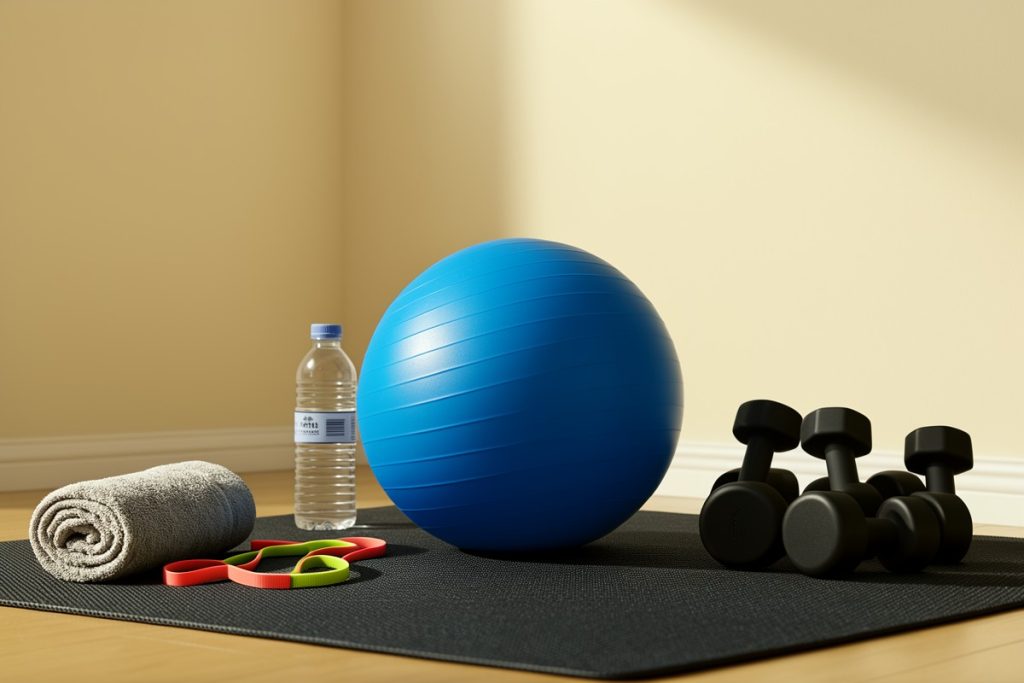
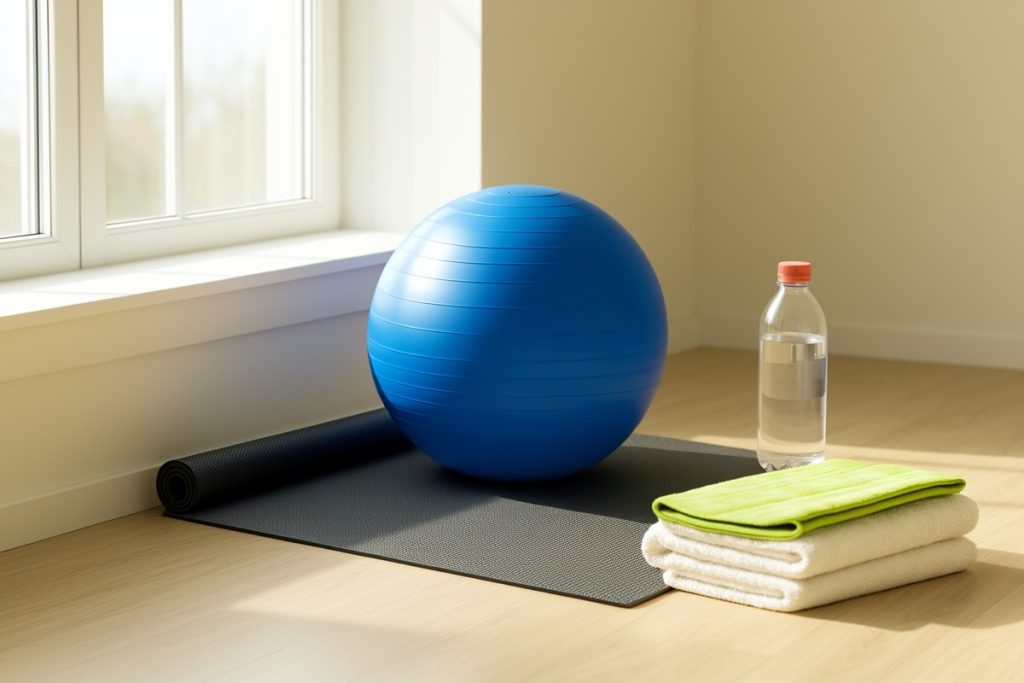
Before exercising, check that the ball is firm, intact, and sitting on a surface with enough traction. Give yourself clear space on every side. Keep it away from sharp furniture edges, pets, and slippery rugs. If you are new to stability training, position the ball near a wall or sturdy counter so you have an easy handhold.
For seated movements, your feet should rest flat and your knees should be comfortably bent. Your hips should not sink dramatically below your knees. If the position feels awkward, adjust the inflation or choose a ball size that suits your height and workspace. Follow the manufacturer’s instructions for inflation and use rather than guessing.
Start with five minutes of easy movement, such as marching in place, shoulder circles, and bodyweight squats. Warm muscles and rehearsed movement patterns make it easier to focus on control once the ball enters the routine.
A 20-minute yoga ball routine for beginners
Complete the following circuit two or three times. Rest for 30 to 60 seconds between exercises, and take longer breaks whenever your technique deteriorates. The goal is steady, repeatable movement—not racing through the list.
| Exercise | How to perform it | Starting dose |
|---|---|---|
| Seated balance march | Sit tall with feet wide. Lift one foot a few centimeters, replace it, then alternate without leaning. | 30 seconds |
| Wall-supported ball squat | Place the ball between your lower back and a wall. Bend your knees slowly, then press through your feet to stand. | 8 to 12 reps |
| Glute bridge | Lie on your back with calves on the ball. Brace your midsection, lift your hips, pause, and lower with control. | 8 to 12 reps |
| Dead bug with ball press | Lie on your back and gently press the ball between your hands and thighs. Extend one leg at a time while keeping your back controlled. | 6 to 8 per side |
| Seated torso rotation | Sit tall with feet planted. Rotate your ribcage gently from side to side while keeping your hips facing forward. | 8 per side |
How to make each movement count
Seated balance march: Do not chase a dramatic leg lift. Keep the movement small enough that your torso stays upright. Progress by narrowing your foot position slightly, but return to a wider stance if you start gripping the ball or holding your breath.
Wall-supported ball squat: Keep your knees tracking in the same direction as your toes. Descend only as far as you can maintain a stable foot position. The wall gives you support, so use it to practice a smooth squat rather than dropping quickly into the ball.
Glute bridge: The ball makes the exercise more demanding because your legs must control its position. Begin with a short range of motion. Keep your ribs relaxed and avoid arching your lower back to lift your hips higher.
Dead bug with ball press: This is a control exercise for your trunk. Exhale as you extend one leg, and reduce the range if your lower back lifts away from the floor. You can practice the press without moving your legs before progressing.
Seated rotation: Move from your upper back rather than forcing your lower back to twist. Keep the rotation comfortable and deliberate. This is not a contest to see how far you can turn.
Progress without losing control
Use one progression at a time. First add a few seconds or repetitions. Then add another round. After that, you can experiment with a slower lowering phase or a slightly narrower stance. Keep the exercise simple until you can repeat it with consistent breathing and alignment.
A useful rule is to finish most sets with two or three good repetitions still available. You should feel that the muscles worked, but you should not need to compensate by bouncing, holding your breath, or rushing. Strength gains come from gradually increasing a manageable challenge, not from making every session chaotic.
Include conventional strength exercises elsewhere in your week, such as split squats, rows, push-ups, hip hinges, or loaded carries. The Physical Activity Guidelines for Americans recommend that adults combine regular aerobic activity with muscle-strengthening work. A yoga ball is one helpful tool inside that larger plan.
When a yoga ball is worth buying
A stability ball makes sense if you want one compact item that can support several kinds of movement. It is especially practical for beginners who need an approachable way to add balance work, or for home exercisers who want a short movement break between longer workouts.
One candidate is the Trideer Yoga Ball for Exercise, Pilates, Core & Balance Training, Stability Ball for Pregnancy & Birthing Prep, Physical Therapy, Daily Stretching, Office Chair for Active Sitting, Quick Pump Included. The listing identifies a quick pump as part of the package. Before choosing it, check the available dimensions, inflation guidance, surface space, and stated user limits. I have not independently tested this product, so treat the manufacturer’s specifications as information to verify rather than a guarantee of comfort or durability.
If you are considering a ball for pregnancy or postpartum exercise, do not assume that a product description is medical advice. Ask your obstetric or physical therapy professional which movements are appropriate for your stage of pregnancy, symptoms, and health history. Stop if you experience pain, bleeding, leaking fluid, faintness, chest pain, or unusual shortness of breath.
Common mistakes to avoid
- Choosing an unstable surface first: Learn the movement on the floor or with wall support before adding the ball.
- Inflating by feel alone: Use the manufacturer’s instructions so the ball is neither excessively soft nor overinflated.
- Going too fast: Slow repetitions reveal whether you can control your hips, ribs, and knees.
- Using it as a full-time chair: Active sitting can be a brief movement variation, but it is not a substitute for changing position and taking regular breaks.
- Ignoring warning signs: Sharp pain, numbness, dizziness, or loss of control means the session should stop.
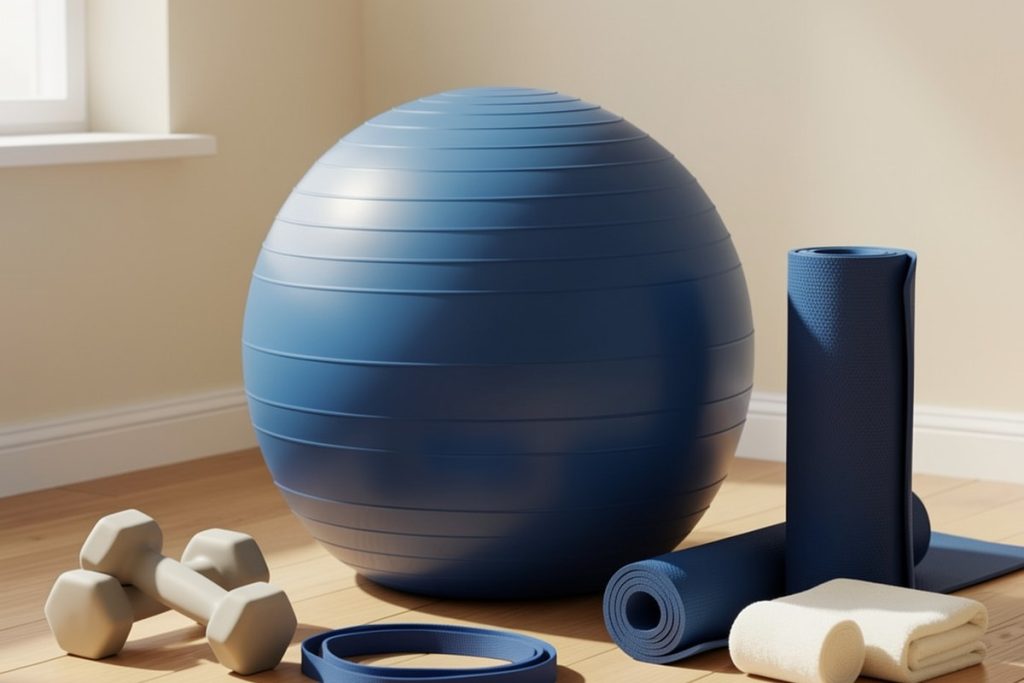
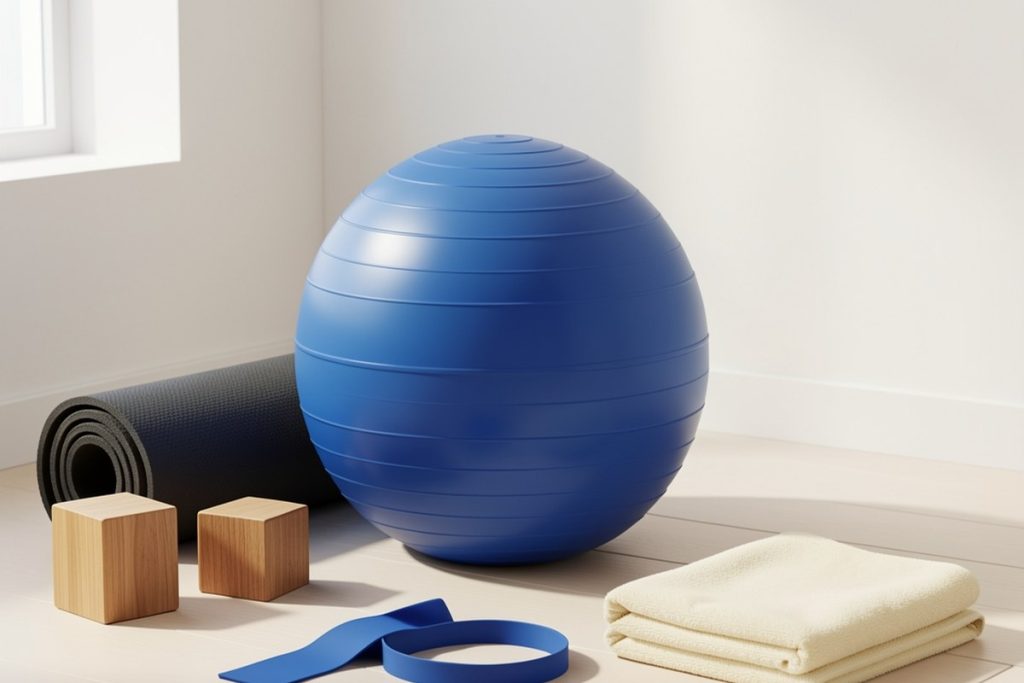
Consistency beats novelty. Set the ball beside your mat, perform the routine two or three times weekly, and record which movements feel stable enough to progress. That simple habit turns a piece of home equipment into a repeatable training plan.
Last reviewed: 2026-08-24
Sources
- Physical Activity Guidelines for Americans, 2nd edition — U.S. Department of Health and Human Services
- Adult Activity: An Overview — Centers for Disease Control and Prevention
- Physical Activity and Exercise During Pregnancy and the Postpartum Period — American College of Obstetricians and Gynecologists