

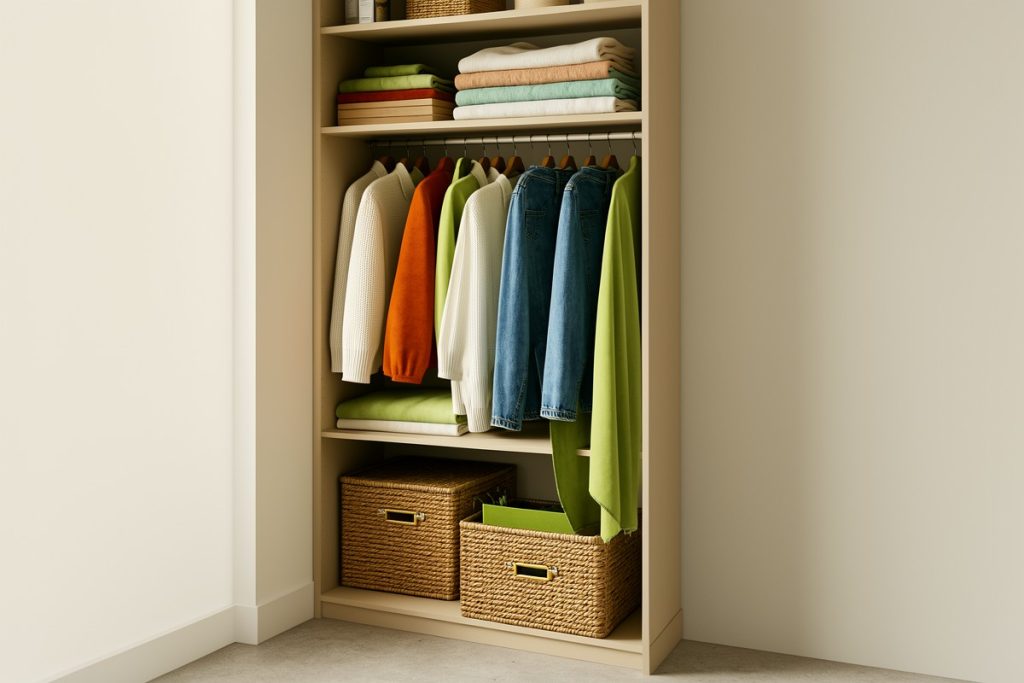
Quick answer
Organize a small closet for seasonal clothes by keeping current essentials at eye level, storing off-season pieces clean and completely dry, and using vertical space for trousers, scarves, and lightweight layers. Sort before buying containers, protect delicate fabrics, and leave enough room to see what you own. A simple twice-yearly rotation prevents the closet from becoming permanently overcrowded.
Key takeaways
- Rotate clothes twice a year instead of storing every season together.
- Wash or air out garments, repair them, and make sure they are fully dry before storage.
- Use vertical hanging space for trousers and scarves, while folding knits and delicate items.
- Choose breathable storage for natural fibers and avoid cramming containers or drawers.
- Keep a small “wear soon” section for transitional weather pieces.
Start with a seasonal closet boundary
A small closet becomes difficult to manage when every item competes for daily attention. Before moving anything, decide what “in season” means for your home. In a cool climate, that might mean keeping warm layers accessible from October through March. In a milder climate, you may need a smaller rotation built around temperature swings rather than a strict summer-and-winter split.
Choose one visible zone for clothes you are likely to wear during the next few months. This could be the main hanging rail, the top two drawers, or the front half of a wardrobe. Everything else belongs in a secondary zone, such as an upper shelf, under-bed container, or separate dresser.
This boundary matters because it reduces visual noise. You should be able to open the closet and quickly see practical choices for the current weather, rather than sorting through linen shirts in January or heavy sweaters during a hot spell.
Sort clothes before buying storage
Take out one category at a time instead of emptying the entire closet onto the floor. Begin with coats and jackets, then trousers, tops, knitwear, accessories, and special-occasion clothing. Place each item into one of four groups: current season, next season, repair or clean, and no longer wanted.
Be specific with the “next season” group. A lightweight jacket may belong there during winter, but it could remain useful during spring rain. Transitional pieces deserve their own small section because they are often worn between seasons. Keeping a few cardigans, trousers, long-sleeve tops, and weatherproof layers nearby is more practical than packing away everything at once.
Use the sorting process to identify duplicates and neglected items. If you repeatedly avoid a garment because it wrinkles easily, feels uncomfortable, or no longer fits your routine, moving it to another container will not solve the underlying problem. Set it aside for a deliberate decision rather than allowing it to take up prime closet space.
Clean, repair, and dry everything first
Never place a visibly dirty or damp garment into long-term storage. Food residue, body oils, and perspiration can become harder to remove over time, while trapped moisture creates an unpleasant environment for fabric. Check the care instructions on each garment before washing, drying, steaming, or sending it for professional cleaning.
Inspect seams, buttons, zippers, hems, and pockets while clothes are out of the closet. A missing button or loose hem is easier to fix before storage than when you discover it during the next seasonal change. Empty pockets, remove temporary accessories, and let recently cleaned garments cool and dry fully before folding them.
Delicate knitwear should generally be folded rather than left hanging for months, especially when the garment is heavy or prone to stretching. Fold pieces loosely, avoid pressing sharp creases into fragile fabric, and do not pack a container so tightly that air cannot circulate when the clothes are removed.
For wool items, follow the garment’s care instructions and use storage guidance from a reliable textile authority. The Woolmark Company recommends clean, dry storage and appropriate protection for wool garments; its care guidance is a useful reference when preparing sweaters for a seasonal rotation.
Match the storage method to the garment
Storage should preserve the shape of the item while making the next rotation easy. Hanging is usually convenient for structured jackets, trousers, skirts, and garments that wrinkle easily. Folding is usually better for bulky sweaters, stretchy knits, and pieces that may lose their shape on a hanger. Scarves and small accessories need containment so they do not disappear behind larger garments.
| Garment type | Practical storage choice | Common mistake to avoid |
|---|---|---|
| Heavy sweaters | Folded on a shelf or in a breathable container | Leaving them on thin hangers for months |
| Trousers and jeans | Vertical multi-level hanging space or a dedicated drawer | Stacking them so the pairs underneath are forgotten |
| Scarves and belts | One basket, divider, or hanging organizer | Mixing them with everyday tops |
| Coats and tailored jackets | Sturdy hangers with room between garments | Overcrowding the rail |
| Delicate clothing | Clean, folded, breathable storage | Sealing it away while damp |
If trousers or scarves are taking over the rail, a three-pack of space-saving velvet pants hangers may be a practical option for using vertical hanging space. Treat it as one tool, not a complete closet solution: confirm that the hanger style suits your rod, available clearance, and the garments you plan to hang.
Use vertical space without creating a squeeze
In a small closet, the most useful space is often above or below the main rail. Add a shelf riser for folded clothing, use the back of a door for lightweight accessories, or place a low basket beneath hanging garments. Keep heavier storage lower and reserve high shelves for items you use only occasionally.
Vertical storage works only when categories remain visible. Do not create a tall stack of identical containers that requires unpacking everything to find one scarf. Use open baskets or clear category boundaries where practical, and leave a little empty space so garments can be removed without pulling down the rest.
For a narrow wardrobe, arrange clothing by frequency rather than color alone. Put daily items in the easiest-to-reach position, transitional layers next, and special-occasion or next-season pieces farther away. This arrangement saves time every morning and makes it obvious when the closet is becoming too full.
Build a twice-yearly rotation routine
Choose two calendar points for a closet review, such as the start of spring and the start of autumn. The exact dates matter less than making the process predictable. During each rotation, remove the previous season’s clothing, inspect it, and decide what should return, be repaired, donated, or replaced.
Keep a small “wear soon” area for garments that suit changing weather. When the forecast shifts, you can shop this section first instead of opening every storage container. Store similar items together, and place the most recently used pieces toward the front so the next transition takes less effort.
A short inventory note can also prevent unnecessary purchases. Record gaps such as “one warm everyday layer” or “weatherproof shoes needed,” rather than writing a vague list of things you might want. The goal is not a perfect capsule wardrobe; it is a closet that reflects your actual season and routine.
Seasonal closet checklist
- Remove clothes that no longer suit the weather.
- Separate current, next-season, repair, and unwanted items.
- Follow care instructions and clean garments before long-term storage.
- Make sure every item is fully dry before folding or packing it.
- Fold heavy knits and hang structured clothing on suitable hangers.
- Keep transitional layers accessible.
- Leave enough space to see and remove items without disturbing the whole closet.
Last reviewed: 2026-09-18