
Quick answer
An ab roller can build core strength at home, but beginners should treat it as an anti-extension exercise, not a race to roll farther. Start from your knees, brace your ribs and pelvis, use a short pain-free range, and stop before your lower back arches. Two or three controlled sets per week are enough to begin; progress only when every repetition looks the same.
Key takeaways
- The goal is to resist lower-back arching while keeping your ribs, pelvis, and shoulders controlled.
- A shorter rollout with steady breathing is more productive than a long, shaky repetition.
- Use a knee pad and begin with two or three sets of four to eight repetitions.
- Progress by adding range or repetitions—not both at once.
- Sharp pain, numbness, or persistent discomfort means you should stop and seek appropriate professional advice.
By Coach Amy Lin, Sustainable Fitness Coach
What an ab roller actually trains
The ab roller is often marketed as an “ab exercise,” but its main challenge is more specific: your trunk must resist extending as the wheel moves away from your body. In practical terms, your abdominal muscles help keep your ribs and pelvis aligned while your shoulders, arms, hips, and glutes contribute to a controlled movement.
That makes the exercise useful for people who want a compact home strength tool, but it also explains why poor form can quickly turn a rollout into a lower-back exercise. If your hips drop, your ribs flare, or you rush the return, your body may compensate by extending through the lumbar spine.
An ab roller will not reduce belly fat by itself or replace a complete training plan. The broader goal is consistent muscle-strengthening activity alongside regular aerobic movement. The Physical Activity Guidelines for Americans recommend muscle-strengthening activity for all major muscle groups on at least two days each week, but they do not require any particular piece of equipment.
Are you ready to try a kneeling rollout?
You do not need to pass a formal test before using an ab wheel. However, a few basic abilities can make the learning process more comfortable. You should be able to brace gently without holding your breath, support your body in a modified plank, and move your shoulders overhead without sharp pain. If those positions feel difficult, start with simpler exercises rather than forcing the rollout.
Good preparation options include dead bugs, elevated planks, bear-position holds, and slow shoulder reaches from a stable tabletop position. These exercises teach you to keep your trunk steady while your limbs move. Practice them for a few weeks if needed; building control first is not taking a shortcut.
Anyone managing an active back, shoulder, wrist, or abdominal injury should get individualized guidance before adding a demanding core exercise. A history of discomfort does not automatically rule out the ab roller, but it does make technique and exercise selection more important.
How to do your first ab roller repetition
- Set up on a supportive surface. Kneel on a mat with the wheel directly below your shoulders. Place your hands evenly on the handles and keep your wrists as neutral as the equipment allows.
- Create a strong starting position. Gently squeeze your glutes, bring your ribs down, and imagine your belt buckle moving slightly toward your ribs. Do not aggressively round your back; aim for a controlled, neutral position.
- Brace before moving. Take a breath into your sides and back, then maintain light abdominal tension. You should still be able to breathe rather than locking your breath throughout the repetition.
- Roll only a few inches at first. Move the wheel forward slowly while keeping your hips stacked over your knees and your lower back from sinking. The correct stopping point is the farthest distance you can control without losing position.
- Return with control. Press the floor away and draw the wheel back beneath your shoulders. Think about bringing your torso back as one unit instead of yanking with your arms.
- Rest before form deteriorates. Start with two or three sets of four to eight repetitions, resting about a minute between sets. End the set when you can no longer control the same range.
A simple four-week progression
This sample progression is deliberately conservative. It is a framework, not a requirement to advance on a fixed schedule.
| Phase | Main focus | Suggested practice |
|---|---|---|
| Week 1 | Bracing and breathing | Dead bugs and elevated planks, two controlled sets |
| Week 2 | Short-range control | Kneeling rollouts of only a few inches, two sets of four |
| Week 3 | Repeatable technique | Two or three sets of five, stopping before your back arches |
| Week 4 | Small progression | Add one or two repetitions or a little range, not both |
Stay at the same phase if your breathing becomes strained, your hips shift, or your lower back feels more than mild muscular effort. Strength improves through repeatable work, not through collecting difficult repetitions.
Five common ab roller mistakes
- Rolling too far: Range of motion is only useful when you can control it. Put a wall, box, or other clear stopping point in front of the wheel if you tend to overreach.
- Letting the hips sag: A sagging position usually means the rollout has exceeded your current trunk strength. Shorten the movement and squeeze your glutes.
- Pulling with the arms: Your arms guide the wheel, but they should not do all the work. Keep your shoulders active and focus on moving your torso as a unit.
- Holding your breath: A brief brace is useful, but repeated breath-holding can make the exercise feel harder than necessary. Use a controlled inhale and exhale that matches your effort.
- Training it every day: The ab roller is strength work. Give the muscles time to recover, especially when you are also lifting, running, or doing demanding sports.
Choosing a basic home ab roller
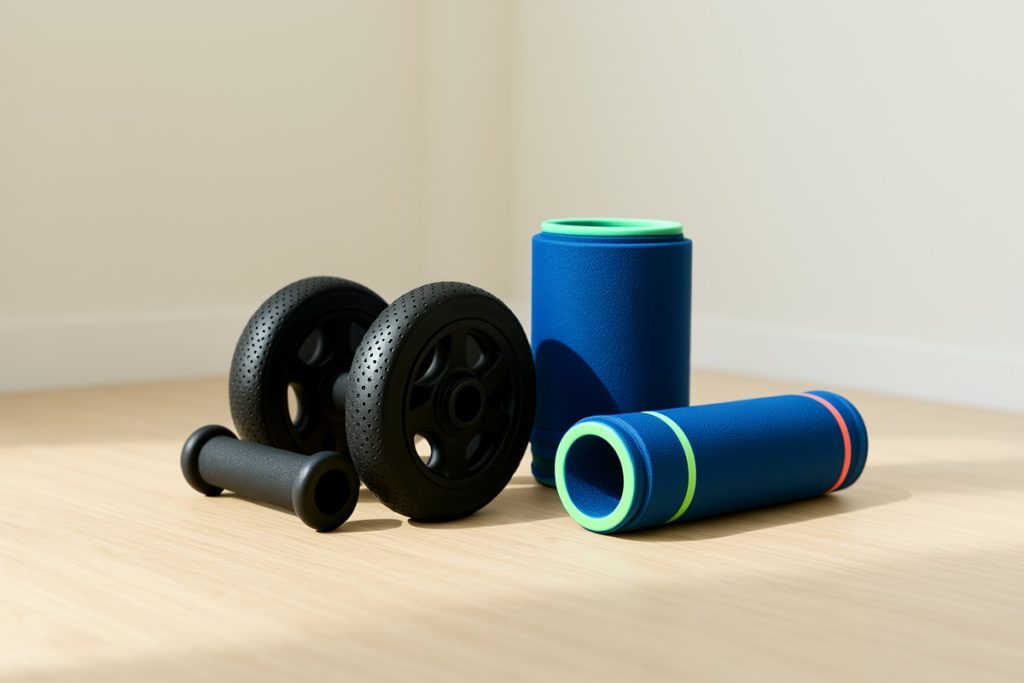
If your main problem is having limited space or no convenient core equipment, the VINSGUIR Ab Roller Wheel is a simple option that includes an ab wheel and knee pad accessories. That combination addresses two practical beginner needs: a compact tool and some cushioning for kneeling.
It is not essential equipment, and the presence of a knee pad does not guarantee that the wheel will feel comfortable or suitable for every user. I have not personally tested this product, so consider the listed design and accessories rather than assuming a specific level of stability, comfort, or durability. Before buying, check whether you have enough clear floor space, whether the handles suit your grip, and whether your planned range of motion matches your current ability.
A towel or exercise mat can provide temporary knee comfort, while dead bugs and planks can train similar bracing skills without equipment. The best choice is the one that lets you train consistently and safely.
When to stop and choose an easier variation
Normal effort may feel like abdominal fatigue, shoulder work, or general exertion. Stop if you experience sharp pain, sudden pinching, numbness, tingling, or pain that changes the way you move. If discomfort continues after training or repeatedly returns, speak with a qualified healthcare professional.
To make the movement easier, reduce the range, place the wheel on a surface with a clear endpoint, or return to an elevated plank and dead-bug variations. To make it harder later, add a small amount of range while keeping the same controlled tempo. A strong rollout is quiet, steady, and repeatable—not dramatic.
Last reviewed: 2026-10-02
Sources
- Physical Activity Guidelines for Americans, 2nd edition — U.S. Department of Health and Human Services.
- WHO Guidelines on Physical Activity and Sedentary Behaviour — World Health Organization.